

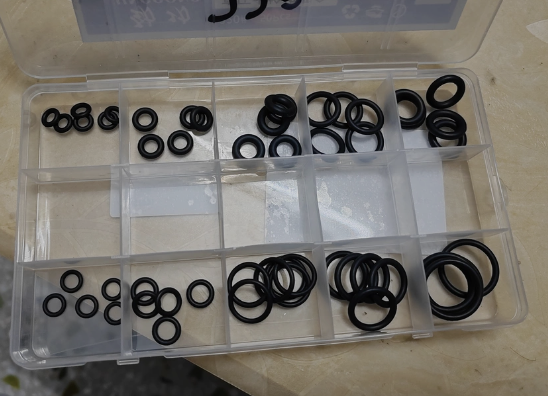
How Do O-Rings Work? Understanding O-Ring Sealing Principles
O-rings are simple-looking rubber components, but they play an important role in preventing fluid and gas leakage in countless industrial applications.
So, how do O-rings work?
An O-ring works by being compressed between two mating surfaces. The deformation of the elastomer creates a sealing force that helps prevent liquids or gases from passing through the gap between the components.
Although the basic principle is simple, reliable O-ring sealing depends on many factors, including the O-ring material, hardness, groove design, compression, pressure, temperature, and operating environment.
This article explains the basic O-ring sealing principle and the factors that determine how well an O-ring performs.
What Is the Basic Principle of an O-Ring?
An O-ring is a circular elastomer seal with a round cross-section.
When an O-ring is installed into a properly designed groove and compressed against a mating surface, the rubber deforms.
This deformation creates contact pressure between the O-ring and the surrounding surfaces.
The contact pressure helps close the sealing gap and prevents the fluid or gas from passing through.
In simple terms:
The O-ring works by using the elasticity of rubber to maintain sealing contact between two surfaces.
This is why the correct amount of compression is so important.
Too little compression may result in leakage, while excessive compression can increase friction, accelerate wear, or damage the seal.
How Does an O-Ring Create a Seal?
The sealing process can be understood in several stages.
1. The O-Ring Is Installed
The O-ring is placed inside a specially designed groove.
The groove controls the position of the O-ring and helps prevent excessive movement during operation.
2. The Mating Components Come Together
When the two components are assembled, the O-ring is compressed between the groove and the mating surface.
The circular cross-section becomes slightly deformed.
3. The Rubber Creates Contact Pressure
Because elastomers are flexible materials, the compressed O-ring attempts to return to its original shape.
This elastic recovery creates contact pressure against the sealing surfaces.
4. Fluid Pressure Can Increase the Sealing Force
When pressure is applied, the fluid can push against the O-ring.
In a properly designed sealing system, this pressure can help force the O-ring against the lower-pressure side of the sealing gap.
This is one reason O-rings can provide effective sealing in many pressurized applications.
Static vs Dynamic O-Ring Sealing
O-rings can be used in both static and dynamic applications.
Static O-Ring Seals
In a static application, the sealing surfaces do not move relative to each other.
Examples include:
- Pipe connections
- Valve bodies
- Flanges
- Covers
- Hydraulic fittings
- Equipment housings
Static sealing is generally less demanding because there is little or no sliding movement.
However, correct compression, groove dimensions, surface finish, and material selection are still essential.
Dynamic O-Ring Seals
In a dynamic application, one component moves relative to the O-ring.
The movement may be:
- Reciprocating
- Rotating
- Oscillating
Examples include:
- Hydraulic cylinders
- Pneumatic cylinders
- Pumps
- Rotating shafts
- Actuators
Dynamic sealing introduces additional challenges such as friction, wear, lubrication, heat generation, and extrusion.
For this reason, an O-ring that performs well in a static application may not necessarily be suitable for the same application when movement is introduced.
Why O-Ring Compression Matters
Compression is one of the most important factors in O-ring design.
If the O-ring is not compressed sufficiently, it may not maintain enough contact pressure against the sealing surfaces.
This can result in leakage.
On the other hand, excessive compression can cause:
- High friction
- Increased installation force
- Accelerated wear
- Compression set
- Permanent deformation
The correct compression depends on factors such as:
- Static or dynamic application
- O-ring material
- Hardness
- Groove design
- Temperature
- Pressure
- Expected service life
Therefore, O-ring dimensions should not be selected independently from the groove and mating components.
How Pressure Affects O-Ring Sealing
O-rings can be used in both low-pressure and high-pressure systems.
When fluid pressure increases, it can push the O-ring toward the low-pressure side of the sealing gap.
This can increase the contact force between the O-ring and the sealing surfaces.
However, excessive pressure can also create a risk of extrusion.
Extrusion occurs when the rubber is forced into the clearance gap between mating components.
If the clearance is too large or the pressure is too high, the O-ring can become damaged.
For demanding high-pressure applications, engineers may use:
- Harder O-ring compounds
- Smaller extrusion gaps
- Backup rings
- Optimized groove designs
The Importance of O-Ring Material
The rubber material strongly influences how an O-ring behaves during operation.
Different materials provide different combinations of:
- Temperature resistance
- Chemical resistance
- Oil resistance
- Flexibility
- Compression set resistance
- Abrasion resistance
- Weather resistance
Common O-ring materials include:
- NBR
- FKM
- EPDM
- Silicone
- HNBR
For example, NBR is commonly used for oil and hydraulic applications, while FKM is often selected for applications requiring higher temperature and fuel resistance.
For more information, see our guide to O-ring material selection.
You can also compare the performance of NBR and EPDM O-rings for different sealing environments.
How Temperature Affects O-Ring Performance
Temperature can significantly affect elastomer performance.
At high temperatures, rubber may become softer, lose mechanical properties, or experience accelerated aging.
At very low temperatures, some elastomers can become harder and less flexible.
The O-ring must therefore maintain sufficient elasticity throughout the expected operating temperature range.
Selecting an appropriate material is especially important when the equipment experiences large temperature changes.
What Causes an O-Ring to Leak?
O-ring leakage can occur for many different reasons.
Common causes include:
- Incorrect O-ring size
- Incorrect compression
- Damaged sealing surfaces
- Improper groove dimensions
- Excessive pressure
- Excessive clearance
- Incorrect material
- Chemical incompatibility
- Excessive temperature
- Installation damage
- Compression set
- Extrusion
An O-ring itself is rarely the only factor responsible for sealing performance.
The complete sealing system—including the groove, mating surfaces, material, operating conditions, and installation process—must be considered.
For a more detailed explanation of common problems, see our guide to common O-ring failures.
Why O-Ring Groove Design Matters
The groove provides the space in which the O-ring is installed.
A properly designed groove should control:
- O-ring compression
- O-ring expansion
- Clearance
- Installation position
- Pressure exposure
The groove must also provide enough space for the elastomer to deform without excessive stress.
For dynamic applications, groove design becomes even more important because the O-ring must accommodate movement while maintaining an effective seal.
How Do O-Rings Work in Real Applications?
The basic sealing principle remains the same across many industries.
O-rings are used in:
- Automotive systems
- Hydraulic equipment
- Pneumatic equipment
- Industrial machinery
- Pumps and valves
- Refrigeration equipment
- Household appliances
- Semiconductor equipment
- Chemical processing equipment
However, the actual O-ring specification can vary greatly from one application to another.
An O-ring used in a washing machine may have completely different requirements from one used in a high-temperature automotive system or semiconductor processing equipment.
For an overview of these different applications, see our guide to O-ring applications in industry.
How to Improve O-Ring Service Life
Proper material selection and installation can significantly improve O-ring service life.
Important practices include:
- Select the correct rubber compound
- Use the correct O-ring dimensions
- Maintain appropriate compression
- Control the sealing gap
- Avoid sharp edges during installation
- Use suitable lubrication when required
- Maintain appropriate surface finish
- Avoid excessive temperature and pressure
- Check chemical compatibility
Proper storage is also important because elastomers can deteriorate when exposed to heat, ozone, sunlight, and unsuitable environmental conditions.
For more information, see our guide to improving rubber seal service life.
Conclusion
So, how do O-rings work?
The basic principle is simple: an elastomer O-ring is compressed between mating surfaces, creating contact pressure that prevents fluids and gases from passing through the sealing interface.
However, reliable sealing depends on much more than the O-ring itself.
Material selection, hardness, compression, groove design, pressure, temperature, surface finish, and installation all influence sealing performance.
Understanding these factors allows engineers and purchasing teams to select more reliable O-ring sealing solutions and reduce the risk of leakage and premature failure.
For demanding applications, working with an experienced rubber seal manufacturer can help ensure that the O-ring material, dimensions, and compound are matched to the actual operating conditions.
Pingback: O-Ring Squeeze Guide: How to Calculate & Design Rules
Pingback: O-Ring Installation: How to Install an O-Ring Without Damage
Pingback: O-Ring Tolerance: What Engineers and Buyers Need to Know