

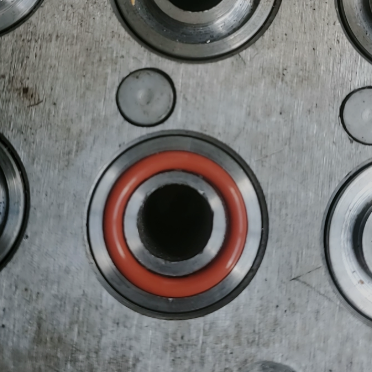
Introduction
When selecting or manufacturing an O-ring, engineers and purchasing teams often focus on material, size, hardness, and operating temperature.
However, O-ring tolerance is equally important.
An O-ring may have the correct nominal inner diameter and cross-section, but if the actual dimensions vary too much, the seal may still experience:
- Leakage
- Excessive compression
- Insufficient sealing force
- Difficult installation
- Premature wear
- Assembly problems
For standard applications, established O-ring standards provide dimensional tolerance requirements. For custom O-rings, engineers and buyers may need to define additional dimensional and material requirements according to the actual application.
This guide explains the basic concept of O-ring tolerance, which dimensions are important, why tolerance matters, and what buyers should communicate to a rubber seal manufacturer.
1. What Is O-Ring Tolerance?
O-ring tolerance is the acceptable dimensional variation around the nominal size of an O-ring.
For example, an O-ring may have a specified nominal inner diameter of:
20.00 mm
The actual manufactured dimension may not be exactly 20.00 mm.
A drawing or applicable standard may specify an allowable tolerance around this nominal value.
In simple terms:
Nominal dimension = target size
Tolerance = acceptable manufacturing variation
The actual O-ring must remain within the specified tolerance range.
Tolerance is particularly important for custom O-rings because the seal must work together with the groove, mating components, pressure, temperature, and other operating conditions.
2. Which O-Ring Dimensions Have Tolerance?
The most important O-ring dimensions normally include:
Inner Diameter (ID)
The inner diameter determines how the O-ring fits around a shaft or inside a housing.
If the ID is too small, installation may stretch the O-ring excessively.
If the ID is too large, the O-ring may not remain correctly positioned during assembly or operation.
For more information, see our:
Cross Section (CS)
Cross section is the thickness of the O-ring.
It directly affects the amount of compression available when the O-ring is installed.
A variation in cross section can therefore influence sealing performance.
For example, if an O-ring cross section is larger than expected, the installed compression may increase.
If it is smaller than expected, the sealing force may be insufficient.
This is why dimensional tolerance should always be considered together with O-ring squeeze.
Read our detailed guide:
Outer Diameter (OD)
Outer diameter is also relevant, particularly when the O-ring is installed into a housing or enclosed groove.
For many O-rings:
OD = ID + 2 × CS
Therefore, variations in ID and cross section can also affect the resulting OD.
3. Why Is O-Ring Tolerance Important?
O-ring tolerance is not simply a manufacturing detail.
It can directly affect the performance of the sealing system.
1. Sealing Performance
The O-ring must achieve an appropriate amount of compression against the mating surfaces.
If dimensional variation causes excessive or insufficient compression, sealing performance may be affected.
2. Installation
An O-ring with dimensions outside the intended range may be difficult to install.
Excessive stretching can make installation more difficult and may also affect the final sealing condition.
Incorrect dimensions can also increase the risk of twisting or damaging the O-ring during assembly.
For more information, see:
and
3. Groove Fit
O-ring dimensions cannot be considered independently from the groove.
The groove controls the O-ring’s position and available space for deformation.
Important groove parameters include:
- Groove width
- Groove depth
- O-ring cross section
- Compression
- Clearance gap
- Corner radius
Our detailed guide explains this relationship:
4. Dynamic Applications
Tolerance can become even more important in dynamic sealing applications.
In hydraulic cylinders, pneumatic equipment, pumps, and rotating equipment, the O-ring may experience:
- Sliding movement
- Friction
- Wear
- Pressure changes
- Temperature changes
Small dimensional differences can influence friction and sealing behavior.
Therefore, dynamic applications often require more careful control of O-ring dimensions, groove design, material, hardness, and surface finish.
4. O-Ring Tolerance and Material Selection
Dimensional tolerance is only one part of O-ring specification.
The rubber compound also affects the final performance of the seal.
Common O-ring materials include:
- NBR
- EPDM
- FKM
- Silicone
- HNBR
- Other specialty elastomers
Different materials have different resistance to:
- Temperature
- Oils
- Fuels
- Water
- Steam
- Chemicals
- Ozone
- Weathering
For an overview of material selection, see our:
O-Ring Material Selection Guide
You can also compare specific materials in:
and
The important point is that tight dimensional tolerance cannot compensate for an incorrectly selected rubber material.
5. Standard O-Ring Tolerances vs Custom O-Rings
There is an important difference between standard O-rings and custom O-rings.
Standard O-Rings
Standard O-rings are manufactured according to established dimensional standards.
Depending on the application and market, customers may specify standards such as:
- AS568
- ISO 3601
- Other regional or industry specifications
Using a recognized standard can make purchasing and replacement easier because the nominal dimensions and tolerance requirements are already defined.
Custom O-Rings
Custom O-rings are different.
A customer may provide:
- Engineering drawing
- 2D CAD drawing
- 3D CAD model
- Sample
- Nominal ID
- Cross section
- Material
- Hardness
- Color
- Tolerance requirements
- Application information
The manufacturer then needs to determine whether the requested specifications can be consistently achieved during production.
For custom sealing components, communication between the engineer, buyer, and manufacturer is particularly important.
6. Should Buyers Always Request Very Tight Tolerances?
Not necessarily.
This is an important point for purchasing teams.
A tighter tolerance does not automatically mean a better O-ring.
Very tight dimensional requirements can increase:
- Tooling requirements
- Inspection requirements
- Production difficulty
- Scrap rate
- Manufacturing cost
- Lead time
If the application does not require extremely tight dimensions, unnecessarily tight tolerances may simply increase the manufacturing cost.
The better approach is to define a tolerance that is appropriate for the actual sealing application.
In other words:
Use the tolerance required by the application, not simply the tightest tolerance available.
This can help balance sealing performance, manufacturing reliability, and cost.
7. What Should Buyers Include in an O-Ring RFQ?
When requesting a quotation for O-rings, purchasing teams should provide as much technical information as possible.
A good RFQ may include:
Basic Dimensions
- Inner diameter
- Cross section
- Outer diameter if applicable
- Dimensional tolerances
Material
For example:
- NBR
- EPDM
- FKM
- Silicone
- HNBR
Hardness
For example:
- 70 Shore A
- 80 Shore A
- 90 Shore A
Operating Conditions
Provide:
- Working temperature
- Working pressure
- Medium or fluid
- Static or dynamic application
- Expected service life
Quantity
For example:
- Prototype quantity
- Trial order
- Monthly demand
- Annual demand
Quality Requirements
Depending on the application, buyers may also request:
- Material certification
- Hardness testing
- Dimensional inspection
- Visual inspection
- Leakage testing
- Batch traceability
- Regulatory compliance
A complete RFQ allows the manufacturer to evaluate the application more accurately and provide a more realistic quotation.
8. How Manufacturers Control O-Ring Dimensions
Manufacturing process control is important for maintaining consistent O-ring dimensions.
Depending on the product and production process, manufacturers may control:
Mold Design
The mold determines the basic geometry of the O-ring.
For custom products, mold dimensions must account for factors such as rubber shrinkage and production conditions.
Rubber Compound
The compound formulation can affect shrinkage, hardness, elasticity, and other physical properties.
Therefore, compound consistency is important for repeatable production.
Vulcanization
Vulcanization conditions can influence the final physical properties and dimensions of the rubber.
Temperature, time, and process conditions must therefore be controlled consistently.
Trimming and Finishing
After molding, flash or parting-line material may need to be removed.
Poor finishing can affect appearance and, in some applications, sealing performance.
Inspection
Manufacturers may inspect:
- ID
- OD
- Cross section
- Hardness
- Appearance
- Surface defects
- Flash
- Other customer-specific requirements
For larger OEM orders, buyers should consider discussing inspection procedures and acceptable limits with the manufacturer before mass production.
9. O-Ring Tolerance and Quality Control
For OEM and industrial applications, tolerance should be included in the quality-control plan.
A practical inspection process may include:
Drawing → Sample → Dimension Inspection → Approval → Mass Production → Batch Inspection
Before mass production, it is often useful to approve samples against the customer’s drawing.
This helps identify problems with:
- Dimensions
- Material
- Hardness
- Mold design
- Flash
- Surface quality
before large quantities are manufactured.
For more information about selecting a suitable supplier, see:
How to Choose a Rubber Seal Manufacturer
10. Tolerance Is Only One Part of O-Ring Reliability
A common mistake is to focus on dimensional tolerance while ignoring the rest of the sealing system.
Reliable O-ring performance depends on the combination of:
Material + Size + Tolerance + Groove + Squeeze + Pressure + Temperature + Installation
If one of these factors is unsuitable, the O-ring may still fail.
For example:
- Correct size + wrong material → chemical failure
- Correct material + excessive squeeze → installation and compression problems
- Correct size + excessive clearance → extrusion
- Correct material + poor installation → damaged seal
- Correct dimensions + poor groove design → leakage
Our guide to Common O-Ring Failures explains some of these problems in more detail.
For high-pressure applications, you can also read our guide to O-Ring Extrusion and our article about O-Ring Back-Up Rings.
11. O-Ring Tolerance for OEM and Custom Applications
For OEM projects, customers often require more than simply an O-ring that “fits.”
The supplier may need to follow a complete technical specification covering:
- Material
- Compound
- Hardness
- Dimensions
- Tolerances
- Mold requirements
- Surface condition
- Inspection requirements
- Packaging
- Traceability
This becomes especially important when the O-ring is installed into equipment that will be manufactured in large quantities.
A small dimensional problem repeated across thousands of components can become a significant production issue.
For this reason, OEM buyers should establish the technical requirements before tooling and mass production begin.
12. Conclusion
O-ring tolerance is an important part of sealing design and manufacturing quality.
The correct tolerance helps ensure that the O-ring fits the intended groove and mating components while maintaining the required sealing performance.
However, tolerance should not be considered separately.
Engineers and purchasing teams should evaluate:
- O-ring size
- Material
- Hardness
- Dimensional tolerance
- Groove design
- Squeeze
- Pressure
- Temperature
- Installation conditions
- Quality-control requirements
For standard applications, established O-ring standards can simplify specification and purchasing.
For custom and OEM applications, a qualified rubber seal manufacturer should be able to review the drawing, material requirements, tolerances, production process, and inspection requirements before mass production.
DRFPART provides custom O-rings and rubber sealing components for industrial and OEM applications. Contact us with your drawing, sample, dimensions, material requirements, or application details to discuss a suitable manufacturing solution.
Pingback: Common Causes of O-Ring Failure: Analysis and Prevention Guide DRFPART
Pingback: O-Ring Size Guide: How to Measure ID, OD & Cross-Section | DRFPART
Pingback: O-Ring Installation: How to Install an O-Ring Without Damage
Pingback: Custom O-Ring Manufacturing: RFQ Guide for Buyers