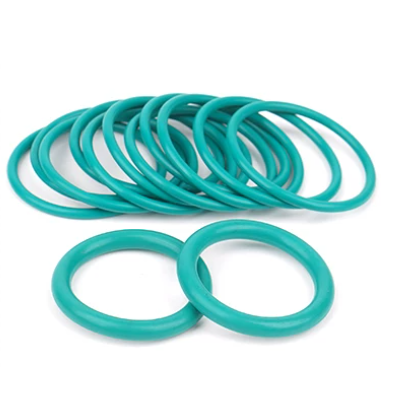

Short answer: a food grade O-ring must satisfy two separate things — the compound must be approved for food contact (FDA 21 CFR 177.2600 in the US, EU 1935/2004 with EU 10/2011 in Europe), and the seal must survive the cleaning regime (CIP/SIP, steam, caustic, acid) without swelling, hardening or leaching. EPDM is the default for water, steam and dairy; FKM for fatty and oily products; platinum-cured silicone for high-temperature dry contact and pharmaceutical use; NBR only in specific low-fat, low-temperature duties. Choosing a “food grade” compound that is chemically wrong for the product is the single most common mistake in this application.
Why Food and Beverage O-Rings Are a Different Problem
In most industrial sealing, the question is mechanical: will this seal hold pressure and survive the temperature? In food and beverage processing, there are three questions at once, and all three have to be answered together:
- Compliance. The rubber must not transfer harmful substances into the product. This is a legal requirement in both the US and the EU, and it is verified through migration testing rather than by a verbal assurance from the supplier.
- Chemistry. The seal has to survive the product (fat, acid, sugar, alcohol) and the cleaning chemicals (caustic soda, nitric acid, peracetic acid, hot water, steam). Cleaning is often more aggressive than the process itself.
- Hygiene. The seal must not create crevices where bacteria can grow, and it should withstand repeated cleaning-in-place (CIP) and sterilisation-in-place (SIP) cycles without degrading.
A compound can be fully compliant and still fail in service within weeks — because compliance says nothing about chemical resistance. That distinction drives everything that follows.
1. The Regulatory Framework: What “Food Grade” Actually Means
United States: FDA 21 CFR 177.2600
Rubber articles intended for repeated use in contact with food are covered by 21 CFR 177.2600 (“Rubber articles intended for repeated use”). The regulation lists the permitted base polymers, cure systems, antioxidants and processing aids, and it sets limits on extractables after exposure to distilled water and to n-hexane. A compound that is formulated only from permitted ingredients and passes the extraction limits can be described as FDA-compliant.
Three practical points that buyers often miss:
- Compliance belongs to the compound, not the material family. “NBR is FDA approved” is not a true statement — a specific NBR formulation is or is not compliant.
- Carbon black and cure systems matter. Two NBR compounds with the same hardness can differ completely in extractable content.
- Ask for the formulation statement, not just a certificate. Suppliers should be able to state which CFR section applies and confirm the ingredient list against it.
Europe: Regulation (EC) 1935/2004 and Regulation (EU) 10/2011
Regulation (EC) 1935/2004 is the framework regulation for all food contact materials: it requires that materials do not transfer constituents in quantities that could endanger health, change the composition of the food unacceptably, or deteriorate its organoleptic properties. It also requires traceability and a declaration of compliance (DoC).
For plastics, Regulation (EU) 10/2011 sets out the positive list of authorised substances and specific migration limits (SML). Elastomers are not plastics and technically fall outside 10/2011, but in practice the market expectation — and the expectation of most European food processors and OEMs — is that rubber compounds are formulated only from substances on that positive list, and that migration is tested against those limits. This is why European buyers frequently ask a rubber supplier for a 10/2011-style declaration even where it is not strictly the governing text.
Two further points European customers will raise:
- Declaration of Compliance (DoC) — a documented statement listing the legislation complied with, the intended use conditions (contact time, temperature, food types) and the supporting test data. A supplier that cannot provide a DoC is not a serious food-grade supplier.
- Migration testing per intended use. The test conditions depend on the food simulant (aqueous, acidic, fatty, alcoholic) and on temperature and contact time. A generic “food contact” test report may not cover your actual application.
Hygienic Design: 3-A Sanitary Standards and EHEDG
Compliance covers what the rubber releases into the product. Hygiene covers whether the seal can be cleaned. In dairy, beverage and pharmaceutical plants, the relevant references are the 3-A Sanitary Standards (widely used in North America) and the EHEDG guidelines (Europe).
Neither organisation approves a rubber material directly — they specify design and cleanability requirements for the equipment. In practice this means the seal should be:
- Mounted in an open or fully drainable groove with no dead volume behind the ring
- Made from a compound that does not crack or craze under repeated CIP cycles
- Free of fabric reinforcement, joints or surface defects that trap product
2. Material Selection for Food Contact
EPDM — the default for water, steam and dairy
Outstanding resistance to hot water, steam, caustic cleaning solutions and ozone, which is exactly the chemical profile of most CIP circuits. Available in FDA-compliant and EU-compliant grades, including peroxide-cured variants with low extractables. Typical continuous range −40 °C to +150 °C (steam grades higher for short cycles).
Choose it for: dairy and cheese processing, brewing and beverage lines, water and steam valves, CIP circuit seals, hot-fill applications.
Avoid it for: fatty and oily products, mineral oils and any mineral-oil-based lubricant — EPDM swells badly.
FKM (Fluoroelastomer) — for fatty and oily products
Excellent resistance to fats, oils, and many food acids, with high temperature capability (up to about 200 °C continuous). Food-grade FKM formulations exist with reduced extractables, but the compound selection matters more here than in any other family: standard industrial FKM grades are not food contact compliant, and some cure systems used in general-purpose FKM are not acceptable for food use.
Choose it for: frying and cooking oil circuits, fatty dairy products, meat and ready-meal processing, high-temperature oil-contact seals.
Avoid it for: hot water and steam (it degrades), and low-temperature service.
Silicone (VMQ) — for high temperature and pharmaceutical duty
Wide temperature range (−60 °C to +200 °C), excellent flexibility and very low compression set, which makes it the commonest choice for pharmaceutical and dry-food applications. The critical distinction is the cure system: platinum-cured (addition-cure) silicone is the grade expected in food, dairy and pharmaceutical service because it produces no peroxide by-products; peroxide-cured silicone is cheaper but releases volatile by-products during cure and is generally not accepted where sensitive organoleptic or pharmaceutical requirements apply.
Choose it for: high-temperature dry contact, pharmaceutical and cosmetic equipment, low-temperature applications, sight glasses and closures.
Avoid it for: dynamic high-pressure service (low tear strength) and steam.
NBR — only in specific duties
Food-grade NBR formulations are available and widely used, but NBR’s natural resistance profile (good against oils, moderate against heat, poor against ozone and weather) limits where it makes sense. It is also more susceptible to hardening under repeated caustic CIP than EPDM.
Choose it for: low-fat, low-temperature product contact where oil resistance is genuinely needed.
Avoid it for: steam, hot water, high-temperature CIP, and any application where the seal is exposed to ozone or UV.
3. Material Comparison for Food and Beverage Service
| Property | EPDM | FKM | Silicone (Pt-cured) | NBR |
|---|---|---|---|---|
| FDA / EU compliant grades available | Yes | Yes (specific grades) | Yes | Yes |
| Fat and oil resistance | Poor | Excellent | Fair | Good |
| Hot water and steam | Excellent | Poor | Fair | Poor |
| Caustic CIP (NaOH) | Excellent | Good | Fair | Fair |
| Acid CIP (nitric / phosphoric) | Good | Fair to good | Fair | Fair |
| Continuous temperature | −40 to +150 °C | −20 to +200 °C | −60 to +200 °C | −40 to +120 °C |
| Compression set | Good | Good | Excellent | Good |
| Relative cost | Low | High | Medium | Low |
This table is a starting point, not a specification. Compound formulation within a family changes performance significantly — a well-formulated EPDM will outperform a cheap one in the same CIP cycle by a wide margin.
4. How CIP and SIP Change the Selection
Cleaning-in-place is where most food-grade seal failures actually originate, and it is the factor most often left out of the specification.
What CIP exposes the seal to
- Caustic soda (NaOH), typically 1—3% at 60—85 °C, for organic soil removal
- Nitric or phosphoric acid, typically 0.5—2%, for mineral scale
- Peracetic acid or hypochlorite, as a sanitiser — aggressive to many elastomers, particularly at elevated temperature
- Hot water and steam, for pre-rinse, final rinse and SIP
- Thermal cycling between ambient and 85+ °C, several times a day
The practical consequences
Repeated caustic/hot-water cycling is the harshest routine duty for an elastomer in a food plant. Two things happen over time:
- Volume swell and softening in the early cycles, if the compound is not suited to the caustic concentration — the seal grows, then extrudes or gets damaged during reassembly.
- Hardening and compression set after prolonged hot caustic exposure — the seal stops recovering and begins to leak. This is the most common end-of-life mode for EPDM in CIP circuits.
This is why EPDM dominates CIP-intensive dairy and beverage duties despite its poor oil resistance, and why the compound — not just the polymer — has to be specified for caustic exposure at temperature.
Two questions to ask a supplier about CIP
- Has this compound been tested for volume swell and hardness change in 2% NaOH at 80 °C, and for how many cycles?
- What is the recommended replacement interval under this cleaning regime — not the theoretical service life?
5. Matching Material to Product Type
| Product Category | Typical Media | Recommended Material | Watch Out For |
|---|---|---|---|
| Dairy (milk, cream, cheese) | Fat + hot water CIP | EPDM (fat-tolerant grades) or FKM for high-fat lines | Fat swelling in EPDM; verify compound |
| Brewing and beverage | Water, sugar, alcohol, caustic CIP | EPDM | Peracetic acid sanitiser attack |
| Edible oils and frying | Hot oil, 150—200 °C | FKM | Low-temperature brittleness if also cold-cleaned |
| Meat and ready meals | Fat, protein, hot washdown | FKM or EPDM depending on fat content | Protein soil trapped behind the seal |
| Bottled water and soft drinks | Water, CO₂, acid | EPDM or silicone | CO₂ permeation with silicone |
| Pharmaceutical | Solvents, WFI, steam SIP | Platinum-cured silicone, or FFKM for aggressive solvents | Peroxide-cured silicone not acceptable |
6. Common Mistakes in Food Grade O-Ring Specification
- Treating “food grade” as a material property. It is a property of the compound. Always ask which regulation and which test data support the claim.
- Checking compliance but not chemical resistance. A compliant NBR seal in a steam line is compliant and useless.
- Ignoring the cleaning chemicals. Specifications that list only the product are incomplete; CIP chemistry is usually the true life-limiting factor.
- Accepting a generic test report. A migration test performed with the wrong simulant or the wrong temperature does not cover your application.
- Using peroxide-cured silicone in pharmaceutical or sensitive organoleptic duty. Not acceptable where by-product volatiles matter.
- Not specifying the lubricant. Assembly lubricant must also be food-contact approved, and the lubricant must be compatible with the seal material (mineral-oil grease destroys EPDM).
- Skipping the hygiene design review. A compliant seal in a dead-volume groove still creates a microbial risk.
7. What a Serious Supplier Should Provide
- Compound identification — base polymer, hardness, cure system, and colour
- Regulatory statement — the specific regulation relied on (21 CFR 177.2600, EU 1935/2004, EU 10/2011 alignment) and a declaration of compliance
- Migration or extraction test data from a recognised laboratory, with the test conditions stated
- Material safety data sheet (MSDS/SDS) for the compound
- Recommended service conditions — media, temperature, cleaning regime, and a realistic replacement interval
- Traceability — batch identification so a failed seal can be traced to the compound lot
If a supplier answers “yes, it’s food grade” without offering documents, that is not a food-grade supplier. Our guide on choosing a rubber seal manufacturer covers the same expectation for general industrial sealing.
Frequently Asked Questions
Is silicone or EPDM better for food applications?
It depends on the duty. Silicone is better for high-temperature dry contact and pharmaceutical use, especially platinum-cured grades. EPDM is better wherever water, steam or caustic CIP is involved, which covers most dairy and beverage applications.
Is FKM food safe?
Specific FKM compounds are formulated for food contact and are compliant with FDA and EU requirements. Standard industrial FKM grades are not. Always specify the food-contact grade and request the supporting declaration.
What is the difference between FDA approval and EU compliance for O-rings?
They are separate legal frameworks. FDA compliance refers to 21 CFR 177.2600 and its extraction limits; EU compliance refers to Regulation 1935/2004 (with 10/2011 alignment in practice) and requires a declaration of compliance with migration test data. A compound tested for one market is not automatically accepted in the other.
Can I use a standard NBR O-ring in contact with food?
No. Only compounds specifically formulated from permitted ingredients and tested for extractables are suitable. Standard industrial NBR grades use cure systems and plasticisers that are not acceptable for food contact.
Why do food grade O-ring fail so quickly in CIP circuits?
Because repeated hot caustic and acid cycles are more aggressive than most people expect. Failure usually appears as compression set (hardening and flattening) after prolonged caustic exposure, or as swelling in the early cycles if the compound is unsuitable.
What test data should I ask for?
A declaration of compliance together with migration or extraction test data from a recognised laboratory, stating the simulant, temperature and contact time used — matched to your actual product and cleaning conditions.
Need Food Grade O-Ring for a Specific Process?
DRFPART manufactures custom O-rings and rubber sealing components for industrial and OEM applications, including compounds intended for food contact. Send us your product media, cleaning regime (chemicals, concentration, temperature), operating pressure and the market you sell into — we will confirm the suitable compound and the documentation required for that market before quoting.
Request a food-grade O-ring quotation or material recommendation: contact our engineering team. You can also review our O-ring material selection guide for the underlying comparison of NBR, EPDM, FKM and silicone, and our custom O-ring manufacturing page for the RFQ process.