

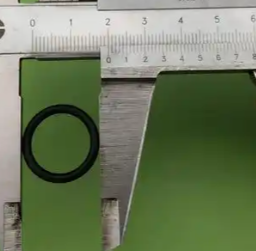
Short answer: an O-ring is defined by three numbers — inside diameter (ID), cross-section (CS), and the resulting outside diameter (OD = ID + 2 × CS). This O-ring size guide explains how to measure each dimension correctly, how the AS568 and ISO 3601 standards work, and how to avoid the sizing mistakes that cause leaks. Never measure a used seal; always confirm dimensions against the equipment drawing before ordering.
Why O-Ring Size Errors Cause Most Leaks
O-ring dimensional errors are one of the most common causes of seal failure — and one of the easiest to avoid. A seal that is 0.2 mm off in cross-section may look correct in the hand but leak within days of installation.
There are three reasons size is harder than it looks:
- Rubber deforms. A used O-ring is stretched, swollen, or compressed. Measuring it gives you the old, failed dimension — not the original spec.
- Three dimensions are linked. ID, CS and OD are not independent. Get the CS wrong and the OD is wrong too, even if the ID is perfect.
- The groove, not the seal, defines success. A “correct” O-ring in a wrong groove leaks; a slightly different O-ring in a well-designed groove may seal perfectly.
This guide covers how to measure an O-ring, how the standards work (AS568, ISO 3601, metric), the mistakes that cause leaks, and how to specify a custom size when nothing standard fits.
1. The Three Dimensions: ID, OD and CS
Inside Diameter (ID)
The inside diameter is the distance across the opening of the ring. It is the dimension most often used to identify a replacement O-ring, and the one you will find on the equipment drawing or parts list.
Cross-Section (CS, also called W — cord thickness)
The cross-section is the thickness of the rubber cord itself. It determines how much the O-ring is squeezed inside the groove, and therefore how much sealing force it generates. Standard cross-sections include 1.5, 1.78, 2.0, 2.5, 3.0, 3.5, 4.0, 5.0 and 5.33 mm.
Outside Diameter (OD)
The outside diameter is the total diameter across the ring, and is derived from the other two:
OD = ID + 2 × CS
Example: ID = 20.0 mm, CS = 2.5 mm → OD = 20.0 + (2 × 2.5) = 25.0 mm
Because OD is calculated, it is never used to identify a seal. If you order by OD, you will almost always get the wrong part.
2. Dimension Reference Table
| Nominal ID (mm) | Common CS (mm) | Resulting OD (mm) | Typical Application |
|---|---|---|---|
| 5.0 | 1.5 | 8.0 | Small pneumatic fittings, sensors |
| 9.0 | 2.0 | 13.0 | Small valves, connectors |
| 15.0 | 2.5 | 20.0 | Hydraulic cartridge valves |
| 20.0 | 2.5 | 25.0 | General industrial housings |
| 31.5 | 3.5 | 38.5 | Pumps, motors, flange faces |
| 50.0 | 5.0 | 60.0 | Large pipe flanges, gearboxes |
| 100.0 | 5.33 | 110.66 | Large vessels, manway covers |
The table above is a guide only. For critical applications, always use the actual equipment drawing rather than a general reference — see section 6 on custom manufacturing.
3. How to Measure an O-Ring Correctly
Tools you need
- Digital caliper (resolution 0.01 mm) — good for ID and CS on rigid, small seals
- O-ring cone / measuring cone — the professional method, especially for soft or large rings
- Optical comparator or vision system — for laboratory-grade verification
Step 1: Measure the Inside Diameter
Lay the O-ring flat on a clean, hard surface. Do not stretch it — a stretched ring reads large. Measure across the inside opening at several positions and take the average. For soft rings, a cone gauge gives a far more reliable ID than a caliper.
Step 2: Measure the Cross-Section
Measure the cord thickness using light contact pressure only. Over-compressing the rubber with a caliper produces a smaller reading and leads to ordering an undersized cord. Measure at four points around the ring and take the average. New O-rings normally have a small manufacturing tolerance (±0.08 to ±0.13 mm depending on size); this is normal and is covered by ISO 3601.
Step 3: Calculate the Outside Diameter
Do not measure the OD directly — calculate it: OD = ID + 2 × CS. This cross-check catches measurement errors. If your measured OD differs from the calculated value by more than the ISO tolerance, re-measure the CS.
Step 4: Compare With the Groove
Measure the groove width and depth, and check the squeeze percentage against the material and application (static seals typically 15–30%, dynamic seals 10–20%). Our O-ring groove design guide covers the calculations.
4. Common Sizing Mistakes That Cause Leaks
| Mistake | What Happens | Correct Approach |
|---|---|---|
| Measuring a used O-ring | The seal has taken a compression set or swollen, so you order the failed size again | Use the equipment drawing, or measure a new spare |
| Ordering by outside diameter | Wrong cross-section, wrong squeeze | Always order by ID × CS |
| Assuming cross-section is standard | A 2.0 mm groove fitted with a 2.5 mm cord will not seat | Verify CS against the groove depth |
| Ignoring tolerance | Within-spec parts from different suppliers can still fail to seal | Quote the ISO 3601 class (see tolerance guide) |
| Stretching the seal to fit | Stretching more than ~5% reduces cross-section and causes leakage | Specify a longer seal; never stretch to fit a groove |
| Skipping the groove check | A correct seal in a badly designed groove leaks | Verify groove width, depth and surface finish |
5. O-Ring Size Standards: AS568, ISO 3601 and Metric
AS568 (SAE Aerospace Standard)
The North American standard, widely used in aerospace, automotive and industrial equipment. Sizes are designated by a three-digit “dash number” (for example -010, -214, -908). The dash number encodes both ID and CS: the -0XX series are standard cord sizes, the -9XX series are larger cross-sections. A dash number is a complete specification — which is why drawings often say “-214 NBR 70” instead of giving dimensions.
ISO 3601
The international standard, accepted across Europe, Asia and most global OEM supply chains. ISO 3601 covers dimensions, tolerances and quality acceptance criteria. It defines tolerance classes (Class A and Class B) — Class A is the tighter grade used for aerospace and precision applications.
Metric O-Rings (JIS / DIN / GB)
Much of Asia and Europe specifies metric sizes by simple ID × CS notation (for example “20 × 2.5”). Japanese JIS (JIS B 2401) and Chinese GB/T 3452.1 sizes are common in machinery imported from those regions. Metric and inch sizes are not interchangeable — a 1.78 mm (0.070″) cord is not the same as a 1.8 mm cord, and mixing them causes leaks.
6. When Standard Sizes Don’t Fit: Custom O-Rings
Standard catalogues cover thousands of sizes, but many industrial applications fall between them. Custom O-rings are the answer when:
- The groove is a non-standard dimension (in-house designed housings)
- The application needs an unusual material or hardness not stocked in the required size
- The seal needs a specific colour, food-grade or FDA/EC 1935-2004 compliant compound
- Volumes are high enough that a dedicated mould is economical
To quote a custom O-ring, a manufacturer needs: ID and CS with tolerances, material and hardness (for example NBR 70 Shore A), the working media and temperature range, static or dynamic duty, and target annual volume. With those details, tooling and lead time can be confirmed quickly — see our custom O-ring manufacturing page for the RFQ process.
Not sure which material suits the application? Our O-ring material selection guide compares NBR, EPDM, FKM and silicone; for the two most common choices see FKM vs NBR and NBR vs EPDM.
7. Quick Checklist Before You Order
- Get the ID and CS from the equipment drawing — not from the worn part.
- Confirm the cross-section matches the groove depth (squeeze within range).
- Quote the standard: dash number (AS568) or ID × CS (metric/ISO 3601).
- State the material and hardness, plus the media and temperature range.
- Ask the supplier to confirm the tolerance class in writing.
- Measure the first delivery against the drawing before installing.
Frequently Asked Questions
How do I know what size O-ring I need?
Identify the inside diameter (ID) and cross-section (CS) — either from the equipment drawing, or by measuring a new seal with a caliper. Order by ID × CS, never by outside diameter.
Can I measure an old O-ring to order a replacement?
Only as a last resort. Used seals are stretched, swollen or compression-set, so the reading can be misleading. Prefer the drawing, or measure a new spare from the same equipment.
What does OD = ID + 2 × CS mean?
The outside diameter equals the inside diameter plus twice the cross-section. It is a calculated value — use it as a cross-check on your measurements, not as the ordering dimension.
What is a dash number on an O-ring?
It is the AS568 (SAE) size designation. A dash number such as -214 fully defines both the inside diameter and the cross-section, so no separate dimensions are needed.
Are metric and inch O-rings interchangeable?
No. For example, a 1.78 mm (0.070″) cord and a 1.8 mm cord are different sizes. Mixing standards is a common cause of leaks and rework.
How much can an O-ring be stretched?
In service, ideally not more than about 5% over its nominal ID. Stretching reduces the cross-section and lowers sealing force, which is why you should specify the right size rather than stretch a smaller ring to fit.
Need Help Specifying the Right Size?
DRFPART manufactures custom O-rings and rubber sealing components for industrial and OEM applications. Send us your groove dimensions, working media and temperature range, and our engineers will confirm the correct ID, cross-section, material and tolerance — free of charge before you commit to a mould or a production order.
Get a free size confirmation or custom quote: contact our engineering team. You can also review our guide to choosing a rubber seal manufacturer to see what to expect from a technical supplier.
Pingback: Custom O-Ring Manufacturing: RFQ Guide for Buyers
Pingback: O-Ring Tolerance: What Engineers and Buyers Need to Know
Pingback: O-Ring Extrusion Guide: Causes, Prevention & Seal Selection
Pingback: O-Ring Groove Design: How to Choose the Right Groove Dimensions